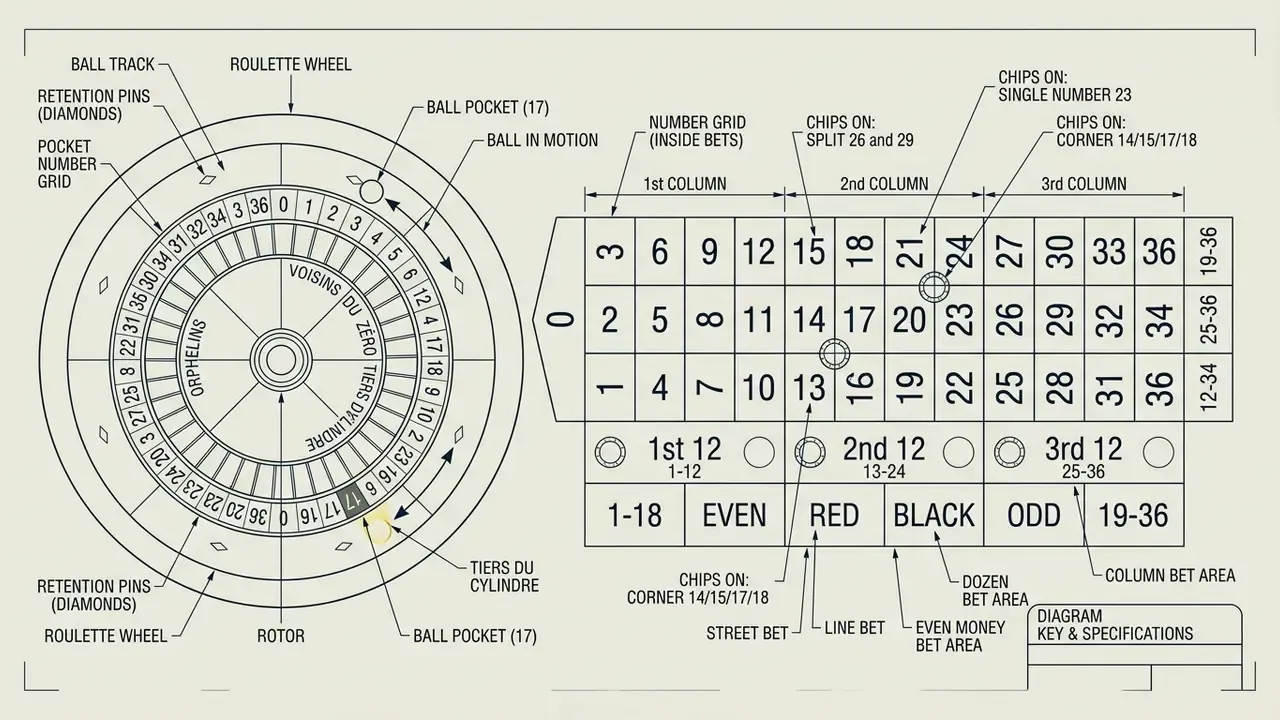
The roulette wheel contains 37 or 38 numbered pockets, and the roulette table features a grid where players place their chips. In European roulette the single-zero pocket sequence on the rim runs: 0, 32, 15, 19, 4, 21, 2, 25, 17, 34, 6, 27, 13, 36, 11, 30, 8, 23, 10, 5, 24, 16, 33, 1, 20, 14, 31, 9, 22, 18, 29, 7, 28, 12, 35, 3. American roulette adds a 38th pocket, the double zero (00), and uses a different pocket order. The table itself splits into two betting zones: the inside area (the numbered grid for specific-number wagers) and the outside area (perimeter fields such as red/black, odd/even, and high/low).
How a round unfolds, step by step:
- Select your chip size on the digital interface or at the physical table.
- Place chips on any inside or outside betting position on the layout.
- The dealer (or software) closes the betting window. In live formats you will hear "No more bets."
- The wheel spins and the ball is launched in the opposite direction.
- The ball comes to rest in a single numbered pocket.
- Losing chips are cleared and winning bets are paid according to the posted payout table.
The round concludes the moment the ball definitively rests in one pocket. Each spin of the roulette wheel is modelled as a discrete random process where outcomes are statistically independent of each other. Past results have no influence on future probabilities.