Table of Content

Blackjack Online: Rules, Strategy, Demo and Real Money Play

Last updated: July 2026

"Before you deposit your first rupee, check the table payout rules and verify the withdrawal options. A big bonus is not always better value, especially for table games. The best way to approach online blackjack is to learn the math, start with demo mode to understand the software, and treat the game strictly as entertainment, not a source of income." - Nisha Rao, Casino and Betting India

Quick Summary

  • Blackjack is a card game against the dealer where the goal is to get closer to 21 without going over.
  • Always look for tables paying 3:2 on a natural blackjack. Avoid 6:5 tables.
  • Start with free demo mode to learn the interface before risking real money.
  • Use basic strategy to reduce the house edge to roughly 0.5 percent, but remember that the casino always retains an edge.

RTP

99.5%

Volatility

Low

Min bet

$0.10

Max bet

$500 or more

Blackjack Online Rules, Strategy, Demo and

What blackjack is and how the game works

Blackjack is a card game played between you and the dealer. The objective? Build a hand total higher than the dealer without exceeding 21. That is the entire premise. Standard blackjack games do not pitch you against other players at the table. Every decision you make focuses on your cards and the single visible dealer card. Indian players exploring online options will find this fundamental structure identical across software-driven blackjack games and live table formats.

Worth noting: the simplicity of the blackjack game is part of its appeal, but also part of the trap. Simple rules do not mean simple outcomes.

What blackjack is and how the

The goal of the hand and the value of cards

The target is to reach a final total closer to 21 than the dealer without going over. Numbered cards retain their printed face value. Face cards (Jacks, Queens, and Kings) count as exactly 10. An Ace counts as either 1 or 11, depending on which value benefits the hand more without causing a bust.

Quick card-value reference:

  • 2 through 10:Face value (a 7 is worth 7).
  • Jack, Queen, King:Worth 10 each.
  • Ace:Worth 1 or 11 (whichever helps the hand).
The goal of the hand and

Your first two cards dictate your immediate course of action. Receiving an Ace and an 8 gives you a soft 19. A soft total means one card can act as 11 without busting the hand. A hard total lacks a flexible Ace. Receiving an 8 and a 9 forms a hard 17.

The mathematical impact of those opening two cards determines your risk exposure. An initial hard 16 carries a high risk of busting if you take another card, whereas a soft 16 allows a free attempt to improve. Players often misinterpret the frequency of 10-value cards. Because a standard deck contains sixteen 10-value cards (four 10s, four Jacks, four Queens, four Kings), the probability of drawing one is notably high. Roughly 30.8 percent of the deck, to be precise. Understand this variable before you play blackjack online.

Your first two cards dictate your

How a round starts with the player and dealer

A round of playing blackjack online starts with the player placing a wager, followed by the dealer dispensing two cards to each participant. The sequence follows a strict order. The blackjack dealer gives the initial two cards to the player face up. The dealer receives two cards as well, with one placed face up and the other acting as the hidden hole card.

The flow of blackjack tables dictates that action begins only after this initial deal completes. The rhythm of this process changes depending on the format you choose.

"In a 2023 online survey of casino game players, 13% found virtual blackjack pacing too fast, 10% found it too slow, and the majority rated the tempo as optimal." - British Gambling Commission, Online Survey of Casino Game Players (2023). https://www.gamblingcommission.gov.uk

Software-driven rounds resolve in seconds. That rapid generation demands clear attention. Start by carefully assessing the opening board before interacting with the user interface.

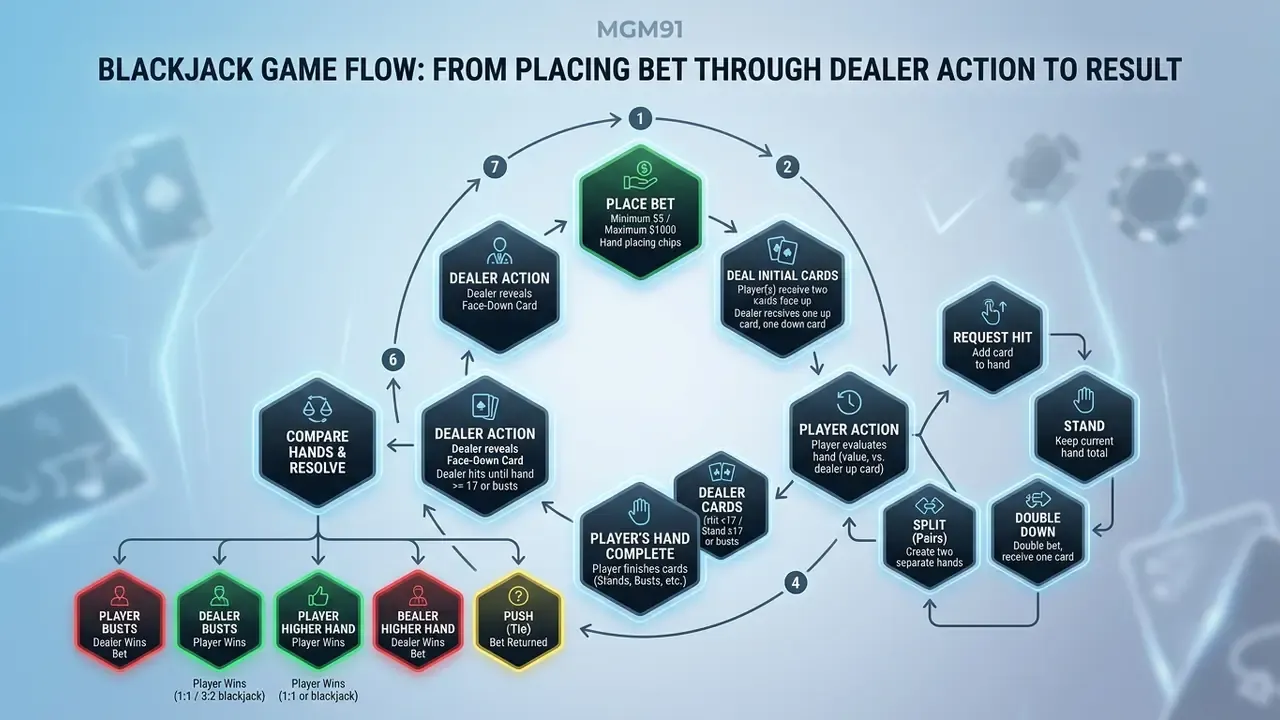
Step-by-step: How a blackjack round works

  1. Place your bet. Select your chip size and confirm the wager before any cards appear.
  2. Dealer deals two cards to you - both face up so you can see your total immediately.
  3. Dealer deals two cards to themselves - one face up (the upcard), one face down (the hole card).
  4. You choose your action: hit, stand, double down, or split (if applicable).
  5. Dealer reveals the hole card and draws additional cards until reaching 17 or higher.
  6. The system compares hands and determines the payout: win, lose, or push (tie).
Software-driven rounds resolve in seconds. That
Blackjack round flow from bet to result

Blackjack rules every player should know before playing

The core blackjack rules govern your choices on the virtual table. You must decide whether to stop, take more cards, or increase your wager based on strict table parameters. Knowing when specific actions apply reduces the house edge and prevents fundamental mathematical errors. Let me walk through the key decisions.

Hit, stand and double after the first two cards

Hitting means requesting an additional card. Standing means locking in your current total. You decide when to hit based on your ongoing hand value. If your total remains low and the dealer shows a strong card like a 10, hitting becomes a statistical necessity. Standing concludes your turn immediately. You evaluate the dealer's visible card before confirming the stance.

A double down allows you to multiply your starting bet by two, but you receive exactly one more card and must stand afterward. The first two cards dictate whether the software permits this move. Many online platforms restrict double options to hard totals of 9, 10, or 11. Executing a double down demands caution. You leverage this move only when the dealer reveals a weak upcard, such as a 5 or a 6. Getting this wrong costs you double.

Hit, stand and double after the

Pairs, insurance and other table-specific rules

Pair rules apply when your first two cards share the identical numerical rank. Splitting a pair divides the hand into two separate entities. You place a second wager equal to your original bet. The hands progress independently. Different blackjack tables impose varying restrictions on splitting. Some tables block players from hitting split Aces more than once, which is a significant limitation worth checking before you sit down.

Insurance acts as an optional side bet triggered when the dealer shows an Ace. You wager half your original stake that the dealer holds a 10-value hidden card. Standard statistical models prove insurance represents a negative expected value decision. The true probability of the dealer having a natural 21 falls short of the 2:1 insurance payout ratio.

Pairs, insurance and other table-specific rules

"Insurance is a negative-EV wager: the probability of the dealer holding a natural blackjack is below the break-even threshold for the 2:1 payout." - Wizard of Odds, Mathematical Rules Analysis (Shackleford framework). https://wizardofodds.com/games/blackjack/

In plain terms: skip insurance. Every time.

Basic Blackjack Actions and Table Rules

ActionWhen AvailableEffect on Hand
HitOn an active player turn before standing or busting.Adds one card to the hand total. Bet remains the same.
StandOn an active player turn.Ends the active turn. Bet remains the same.
Double DownAfter the first two cards, pending specific table rules.Doubles the wager. Adds exactly one card, then forces a stand.
SplitWhen the first two cards form a matching pair.Splits into two hands. Requires a second matching wager.
InsuranceWhen the dealer upcard is an Ace.Creates a separate side bet paying 2:1 if the dealer holds Blackjack.
SurrenderOnly on tables that permit it; usually before any other action.Player forfeits half the bet and the hand ends immediately.

How to play blackjack online: demo, real money and casino modes

Playing blackjack online involves selecting the correct software mode based on your familiarity with the interface. iGaming platforms shape the entire consumer journey. You transition smoothly only when the rules and the operational buttons feel natural. Testing the environment limits financial exposure, and honestly, most players skip this step too quickly.

When blackjack demo is the better starting point

Blackjack demo mode represents the safest starting point for new users. Playing blackjack with virtual credits removes monetary risk during the learning phase. You focus entirely on reading the user interface, locating the basic strategy charts, and pressing the correct action buttons. Accidental clicks occur more frequently than you might expect on mobile platforms.

How to access a demo game:

  • Most regulated casino platforms display a "Play for Free" or "Demo" button directly in the game lobby. Often no registration is required.
  • Look for the game tile and check for a practice or demo toggle before clicking "Play."
  • If the site requires sign-up, you typically do not need to deposit funds to access demo tables.

Running a test session builds comfort before taking active risks. You can experiment with double options and split pairs without depleting capital. Regulatory frameworks strongly support controlled onboarding environments. The safest approach: set rigid expectations inside a demo session, verify that the rules match standard mathematical models, and only then consider committing funds.

A small personal observation: many players who skip demo mode end up making costly interface errors in their first real money session. Misclicking "hit" when you meant "stand" on a hard 18 is a painful way to learn the layout.

When blackjack demo is the better

What changes in blackjack real money play

Transitioning to blackjack real money tables changes the operational pressure and the decision pace. A user interacting with real stakes faces emotional pressure that distorts basic logic. Betting patterns often shift in ways players do not anticipate.

"Players systematically underestimate their actual deposits: transactional data diverges from self-reported spending figures when real money enters the equation." - Journal of Gambling Studies, Self-reported Deposits Versus Actual Deposits in Online Gambling (2024). https://link.springer.com/journal/10899

Online blackjack features strict minimum stakes. Minimum bets on RNG tables typically range from $0.10 (roughly ₹8) up to VIP tables at $500 or more, depending on the platform and the blackjack variation. You must verify local payment rails. For Indian players, depositing via UPI takes seconds, but KYC verification during withdrawal adds procedural friction. Prepare your identity documents before the first hand. A safe casino ensures clear withdrawal rules are visible from the main lobby.

A note on legality for Indian players: Online gambling laws in India vary significantly by state. States such as Telangana and Andhra Pradesh have enacted specific bans on online real-money gaming, while others (like Goa and Sikkim) operate under more permissive frameworks. Always verify your local regulations before placing any real-money wager.

Responsible play monitors measure session density. Some regulated jurisdictions set automatic triggers for player protection. For instance, in New Jersey, deposits exceeding $10,000 within 24 hours or $100,000 within 90 days activate a responsible-gambling review. - New Jersey Division of Gaming Enforcement, Responsible Gaming Best Practices (2023). https://www.nj.gov/oag/ge/

Important: Real money play carries direct financial risk. The transition from demo credits to real funds amplifies emotional bias. Set firm walk-away limits and deposit only what you treat as pure entertainment spend. Stop the session immediately if the outcomes trigger frustration. This is not optional advice. It is the single most important habit you can build.

Disclaimer: The information in this article is for general educational purposes and does not replace professional advice on financial risk management or responsible gambling. Gambling on real money involves financial risk; if you or someone you know struggles with gambling, seek help from a qualified professional.


Online blackjack features strict minimum stakes

Live dealer blackjack vs standard online blackjack

The casino environment offers two distinct modes for the card game: software-driven standard modes and live studio broadcasts. Both host the same fundamental logic, but the delivery mechanisms alter the consumer experience considerably. You choose the mode based on pacing preferences and connectivity limits.

What makes live blackjack different

Live dealer blackjack replaces automated graphic generators with a human professional operating physical cards. The stream transmits from a studio directly to your device. You place digital bets on a visual overlay while the game resolves through manual dealing. Trust markers change entirely. The player views the physical deck leaving the shoe, card by card.

The game rhythm shifts downward. You play live blackjack at the pace dictated by manual card distribution and the combined decision times of multiple players linked to the table. Online blackjack games driven by RNG (Random Number Generators) resolve instantly. The live dealer format provides interactive chat tools, generating a social atmosphere far removed from isolated software tables.

Note that casinos typically offer both shared tables (network-wide, hosting players from multiple sites simultaneously) and exclusive tables (branded to a specific casino, often with dedicated promotions and a VIP feel). Think of shared tables like a casino with multiple entrances, each reserved for a different website. Exclusive tables function like a VIP room where only one platform's players are admitted, often with 24/7 availability.

What makes live blackjack different. Live

Who should choose live casino blackjack

Users who want absolute visual transparency and a relaxed pace should select blackjack live casino formats. Slower distribution provides distinct thinking time. A novice reviewing their basic strategy chart benefits from the built-in delays of a human dealer. There is something reassuring about watching real cards being dealt, too.

Users prioritizing rapid hand volume or playing on unstable mobile internet connections should skip live streams. The video demands heavy data packages. If you prefer high-speed iterations, standard RNG tables load instantly and rely on minimal bandwidth. Consider your device capability and time constraints before choosing the format. A 4G connection dropping mid-hand during a live session can be genuinely frustrating.

Standard Online Blackjack vs Live Dealer Blackjack

Who should choose live casino blackjack
FeatureStandard RNG BlackjackLive Dealer Blackjack
DealerAutomated software algorithm.Real human croupier via video.
Game RhythmInstant settlement. Player controls pace.Slower table pace. Dealer controls speed.
Card MechanicsRandom Number Generator (RNG).Physical cards pulled from a shoe.
Minimum BetsOften as low as $0.10 (₹8).Usually higher due to staffing and streaming costs.
Optimal PlayerPrefers high speed and minimal interaction.Prefers social elements and visual dealing.

The key takeaway: live dealer blackjack is not inherently "better." It is a different experience. Your internet stability, patience, and preference for human interaction should drive the choice.

Not all blackjack tables follow the same rules. Different variations change the deck count, payout structure, or available actions, which directly affects the house edge and playing strategy. Here are the most common types you will encounter online:
  • Classic (American) Blackjack:Played with 6 or 8 decks. The dealer peeks for blackjack on an Ace or 10. Standard 3:2 payout. The most widely available format and, frankly, the best starting point.
  • European Blackjack:The dealer does not receive a hole card until the player finishes acting. No peek rule means you risk losing a double or split bet to a dealer blackjack.
  • Single Deck Blackjack:Uses only one deck, offering the lowest house edge when combined with basic strategy. Harder to find online and often paired with less favorable payout rules to compensate.
  • Spanish 21:Played without the four 10-spot cards (face cards remain). Compensates with bonus payouts and more liberal rules for doubling and late surrender.
  • Blackjack Switch:You play two hands simultaneously and can swap the second card dealt to each hand. Natural blackjack pays even money (1:1) instead of 3:2, which is a significant trade-off.
  • Pontoon:A British variant where both dealer cards are face down. Player "twists" (hits) and "sticks" (stands). Five-card trick (five cards without busting) pays a premium.
  • Multi-Hand Blackjack:Play up to five hands at once against the same dealer. Increases action speed but also multiplies variance. Your bankroll can evaporate quickly if you are not careful.
Popular online blackjack variations. Not all

Understanding these variations helps you target tables with the lowest house edge and the rules best suited to your skill level. If you are new, stick with Classic Blackjack until basic strategy feels automatic.

Blackjack strategy for beginners and regular players

Blackjack strategy defines a strict set of optimal responses to every potential card combination. Mathematics dictate that arbitrary intuition loses capital faster than a disciplined system. Executing accurate strategy relies on continuous discipline and emotional control, and that second part is harder than most people admit.

Basic strategy decisions by your cards and the dealer card

Your first two cards and the dealer upcard construct the full decision matrix. Basic strategy charts analyze these variables to minimize the casino advantage down to roughly 0.5 percent under optimal standard rules. With multiple decks or less favorable table rules, the edge may stretch to about 1.0 percent. - Wizard of Odds, Mathematical Rules Analysis. https://wizardofodds.com/games/blackjack/

If you hold a hard total of 13 through 16 and the dealer shows a 6, strategy dictates a stand. The probability of the dealer busting on a mandatory hit justifies waiting. If the dealer displays an exact 10, that identical hard 16 requires a hit. The statistical threat of a 20 from the house outweighs your own bust risk. Never play on intuition. Apply the mathematical rules consistently across every single hand.

Basic strategy decisions by your cards

Quick strategy cheat sheet

Memorize these rules before sitting down at any table. They cover the most common situations and form the backbone of basic strategy:

  • Always split Aces and 8s. Two Aces give you two shots at 21; two 8s escape the dreaded hard 16.
  • Never split 10s or 5s. A pair of 10s is already 20, nearly unbeatable. A pair of 5s is a strong double-down hand (hard 10), not a split candidate.
  • Stand on hard 12 through 16 when the dealer shows 2 through 6. The dealer's weak upcard means a high bust probability. Let the dealer take the risk.
  • Hit on hard 12 through 16 when the dealer shows 7 through Ace. The dealer likely has 17 or higher already, so you must try to improve.
  • Double down on 10 or 11 when your total exceeds the dealer's upcard. Maximum value extraction when the odds favor you.
  • Never take insurance. It is a negative-EV side bet regardless of your hand.
  • If the table allows surrender, surrender hard 16 against a dealer 9, 10, or Ace. This saves half your bet in the most unfavorable spots.

[IMAGE PLACEHOLDER: Basic Strategy Chart. Caption: "Printable basic strategy chart for 4-8 deck blackjack." Alt text: "blackjack basic strategy chart hit stand double split".]

Quick strategy cheat sheet. Memorize these

Common mistakes when playing blackjack online

Inconsistent betting destroys controlled budgets. Players frequently abandon flat betting when facing brief losing streaks. Escalating bet sizes outside planned limits generates rapid capital depletion.

"The coefficient of the previous bet demonstrates that the wager in round t is nearly equal to the wager in the prior round - players rarely adjust bet sizes within a session." - Empirical Investigation of Wagering Behaviour, Journal of Gambling Studies (2019). https://link.springer.com/journal/10899

Another severe error involves skipping the table rules check. Sitting at a table paying 6:5 for a natural blackjack instantly spikes the house edge. Moving into real money variations without finalizing a clear walk-away point strips the session of control. Emotional responses dictate poor hit or stand choices. I should clarify: this is not just a beginner problem. Experienced players fall into the same trap when frustration builds.

A further common trap is the Martingale betting system, where a player doubles the bet after each loss. While it sounds logical in theory, table limits and finite bankrolls mean a losing streak can deplete funds rapidly. A six-hand losing streak at a ₹100 starting bet already requires a ₹6,400 wager on the seventh hand. Always stick to flat betting within a fixed session budget.

Verification: Fact Check

Myth: Perfect basic strategy guarantees a winning session.

Fact: Strategy solely reduces the mathematical house edge to its lowest possible point. The house retains the ultimate advantage because the player acts first and risks a bust before the dealer moves. Treat strategy as risk mitigation, not an income guarantee. No strategy, no matter how perfectly executed, eliminates the casino's structural edge.

Another severe error involves skipping the

How to choose blackjack games and tables in an online casino

Sorting through various blackjack options requires looking past the visual lobby banners. Casino marketing focuses on flashing promotions. The informed user ignores the graphics and audits the specific mechanical rules running the table. Reviewing iGaming platforms with transparent rule disclosure saves time and money.

What to compare before you join a table

You compare payout ratios first. The most critical table parameter remains the 3:2 payout on a natural hand. Any table displaying a 6:5 rule deserves an immediate skip.

"A 6:5 payout on a natural blackjack instead of the standard 3:2 increases the house edge by approximately 1.4 percentage points under otherwise identical conditions." - Wizard of Odds, Blackjack House Edge Calculator. https://wizardofodds.com/games/blackjack/

You must check whether the dealer stands on a soft 17 or hits. A dealer hitting a soft 17 increases the casino advantage marginally but measurably over thousands of hands.

Verify the minimum table limits. A widely used bankroll guideline suggests your session budget should cover at least thirty minimum bets. For example, at a ₹100 minimum table, bring at least ₹3,000 for the session. This buffer absorbs normal variance without forcing premature exits. (Note: this is a practical guideline, not a rule guaranteed by any mathematical model.)

Measure the interface layout. Check if the buttons separate clearly. Fast visual scans save capital when split-second errors occur on compact mobile screens. On some platforms, the "hit" and "stand" buttons sit uncomfortably close together. Test this in demo mode first.

You must check whether the dealer

Why the right casino offer matters for blackjack play

Understanding promotional restrictions protects your withdrawal timeline. A massive welcome casino bonus heavily targets slot mechanics. Welcome offers usually impose high wagering requirements. Table games carry a severely reduced contribution rate inside these terms.

Case study: A user evaluating platforms on Casino and Betting India spotted a massive ₹100,000 match bonus and intended to clear it on table games. Our audit process revealed that the specific terms locked table game contribution at just 5%. The user realized they would need to place 20 times the stated wagering volume to unlock the funds, prompting them to decline the bonus and play strictly with cash to maintain withdrawal freedom.

Checking the terms prevents bonus fog. A zero-bonus approach provides total control over your funds and ensures zero delayed withdrawals when you decide to log off. This is particularly relevant for blackjack players, since most casino bonuses are designed around slot play, not table games.

Why the right casino offer matters

Red flags: casinos to avoid

Not every platform deserves your trust. Before depositing, watch for warning signs that indicate a poorly run or potentially unsafe casino:

  • 6:5 blackjack payout instead of 3:2. This single rule change increases the house advantage by roughly 1.4 percentage points. Avoid any platform that hides this in fine print.
  • Unclear or missing KYC and withdrawal process. If the casino does not clearly explain identity verification and payout timelines from the main lobby, treat it as a red flag.
  • Live dealer games that freeze or lag frequently. Persistent technical issues during live sessions may indicate underfunded infrastructure or unreliable streaming partners.
  • Bonus terms that exclude table games entirely while advertising massive welcome offers. If the fine print assigns 0% or 5% contribution to blackjack, the bonus is effectively useless for your preferred game.
  • No visible licensing information. A legitimate casino displays its license number and issuing authority. If you cannot find this information, do not deposit.
  • Consistently negative player reviews citing delayed payouts (30 or more days), unresponsive support, or accounts locked after large wins.

Treat this list as a pre-deposit checklist. A platform that triggers even one of these signals warrants extra caution before you commit any funds. When in doubt, step back and research further.

Red flags casinos to avoid. Not

FAQ about blackjack online play

Can I play blackjack online before depositing real money?

Yes. The majority of regulated casino platforms provide a demo testing interface. You can play blackjack and learn the core mechanics using virtual chips. This free path builds comfort with the buttons and allows basic strategy verification prior to initiating financial transactions. Many platforms do not require registration for demo mode. Simply find the game in the lobby and click "Play for Free."

Is live dealer blackjack better than regular online blackjack for beginners?

Live dealer blackjack tends to suit beginners better due to the regulated pacing. A human dealer slows the physical round. This reduction in speed grants a novice extra seconds to consult an educational chart before finalizing a move. However, if your internet connection is unstable or you prefer to take unlimited time per decision, RNG tables (which have no timer) may be a practical alternative while learning. Neither format is objectively "better." It depends on your setup and learning style.

Can I count cards in online blackjack games?

No. Automated continuous shuffling machines (CSM) constantly recycle used physical cards back into the active shoe on live tables. Standard software variations rely directly on an RNG to generate fresh sequence probabilities on every single hand. Both systems prevent a reliable running count. Strategy depends entirely on basic decision mathematics, not card tracking. If someone is selling you a card counting system for online blackjack, save your money.

Is online blackjack legal in India?

Online gambling laws in India are governed at the state level, not centrally. Some states (for example, Goa and Sikkim) permit licensed gaming, while others (such as Telangana and Andhra Pradesh) have explicit bans on real-money online games. Before playing on any platform, verify the regulations applicable in your specific state of residence. This article does not provide legal advice, and the regulatory landscape can shift.

What is the best blackjack variation for a new player?

Classic (American) Blackjack with standard 3:2 payouts, a dealer-stands-on-soft-17 rule, and 6 to 8 decks offers the most widely documented strategy charts and the lowest house edge for beginners. Once you are comfortable with basic strategy, you can explore variations like Spanish 21 or Blackjack Switch for added variety. Start simple. Build from there.

Next steps:

  1. Try a free demo game to get comfortable with the interface and button layout.
  2. Review the quick strategy cheat sheet above. Screenshot it for reference at the table.
  3. Before depositing, confirm the table pays 3:2 for a natural blackjack and check the casino's KYC and withdrawal policies.
  4. Set a session budget, stick to flat betting, and treat every session as entertainment, not income.

Disclaimer: This article is for informational and educational purposes only. It does not constitute financial, legal, or gambling advice. Real-money gambling carries financial risk. Gambling laws vary by jurisdiction. Always verify local regulations before playing. If you or someone you know is struggling with gambling, please seek support from a qualified professional or organization such as BeGambleAware (begambleaware.org) or GamCare (gamcare.org.uk).

Next steps 1. Try a free